1.6. Damage
Damage Types
All Damage comes with a Damage Type. Each Damage Type has a Major and a Minor component.
From the Glossary:
Falling
If ever you fall more than a Spearing Distance(2u), you may be in danger!
When you begin falling, like if someone pushed you off a cliff, if it's not your Turn, the fall itself won't get resolved until your next Turn. On that Turn, you might have a chance to act before falling. For every 10 units you are about to fall, you can use 1 Beat before that fall occurs. If you have no Beats, you can, of course, still borrow from your next Turn, as usual. Once you have used up your allotted Beats or once you end your Turn, whichever occurs first, you will then fall up to a Sniping Distance(100u). If you hit something, you will stop moving there and suffer Damage.
The Damage you take depends on the total Distance that you fell. If you fell a Spearing Distance(2u) or less, you take no Damage. If you fall more than that, you will take 1 Solid/Blunt Damage for each Unit you fell. Like with all Damage, for every 10 Solid/Blunt Damage you take, you will also take 1 Vital Damage. The total Solid/Blunt Damage you can take from falling maxes out at 100. That also means the Vital Damage you can take maxes out at 10. Note that falls of even 40 units will result in the death of most Adventurers, as they generally start with 4 Vitality.
Below is a helpful chart that you can also find on the player reference sheet:
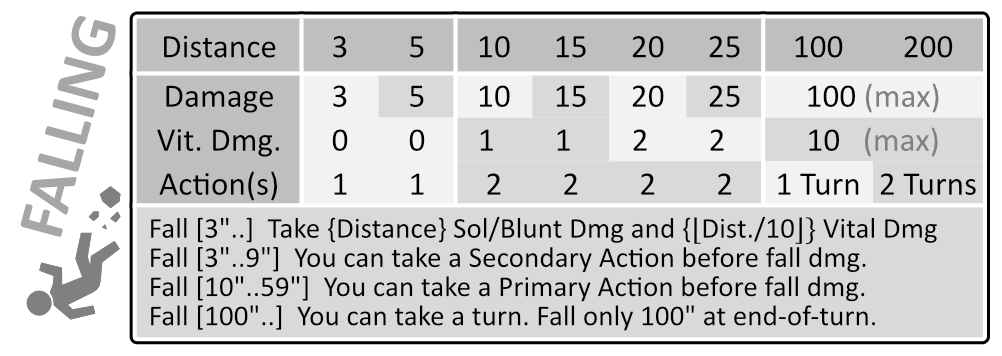
At the top of this chart is the distance to the ground in units. Below that you will find the number of Beats you can take on your next Turn before you fall and possibly take Damage.
Since falls resolve on your Turn, there is a chance that others can save you by acting before you start your Turn. If you want to break the fall of another character by catching them in your arms, you will need to take half of their total fall Damage, rounded down. You can also weaponize this by falling onto unwitting enemies.
The Feather Spell, Tumble Ability, and some Items, like an improvised net, can help save someone that is falling, negating all Damage they would otherwise take. Don't be afraid to improvise solutions to the problem that is 'falling'.
- #Alice gets pushed off a cliff. #Alice is now 79 units above the ground. #Alice remains where she is (airborne) until her next Turn.
- #Alice starts her Turn.
- #Alice gained 3 Beats at the start of her Turn and had 1 extra from her last Turn for a total of 4 Beats. She could borrow 2 Beats from her next Turn, but she feels she doesn't need to.
- Because #Alice is about to fall 79 units, she can take up to 7 Beats total on her Turn.
- A fall of 79 would deal 79 Solid/Blunt Damage to #Alice along with 7 Vital Damage. That would mean certain death to #Alice. #Alice needs to use her Beats wisely.
- Alice uses an Ability that costs 2 Beats, creating a wind to push her along the cliffside so she is above a ledge. The ledge is 12 units below her - a much less dangerous fall.
- Since the ground is now 12 units away, Alice now has a max of 1 Beat she can use before falling. This takes effect immediately and since she is above that limit, Alice must resolve the fall.
- Alice falls the 12 units. Alice takes 12 Solid/Blunt Damage and 1 Vital Damage. Alice is in bad shape, but not Dead.
- Alice uses her remaining 2 Beats to heal herself.
Traps
You will often encounter Traps as you explore dungeons infiltrate the camps of others. Some Traps, like the Scatter Traps, will trigger instantly, but larger Traps work in much the same way that Falling does.
When you trigger a Trap, the GM, or Adventurer that laid the Trap will describe the first moments of the Trap as it's triggered. The GM or Adventurer will give you clues to what is about to happen. You will then have a small window of opportunity to act.
If you trigger a Trap during the Freeplay phase of the game, all your allies will need to perform the Trap's Save. Allies that Pass the Save will have a chance to act before the trap closes on you. If an ally is able to help you in a meaningful way, the GM will allow you to escape or grant you an Advantage on the final Save of the Trap. Your allies do not have to help you, if they do not want to or cannot help you in a meaningful way.
If you trigger a Trap during an Encounter, allies don't need to make a Save. Instead, the Trap will take effect at the start of your next Turn. If you are not out of the way of the Trap when your next Turn starts, you will need to perform any Saves for the test and suffer the Trap's effects.
There're simple ways that an ally can help. An ally could try to push you out of the way of the Trap. To push someone, you can use the Grapple Ability. If the target is willing, the Grapple Ability can be an automatic Mixed Score. Attempting to save someone could put you in the way of the Trap, if you roll a Low Score or Mixed Score. In those cases, you will need to perform the final Save against the Trap and you may experience the effects of the Trap.
Next Up: 1.7. Zones