3.5. Wealth Box
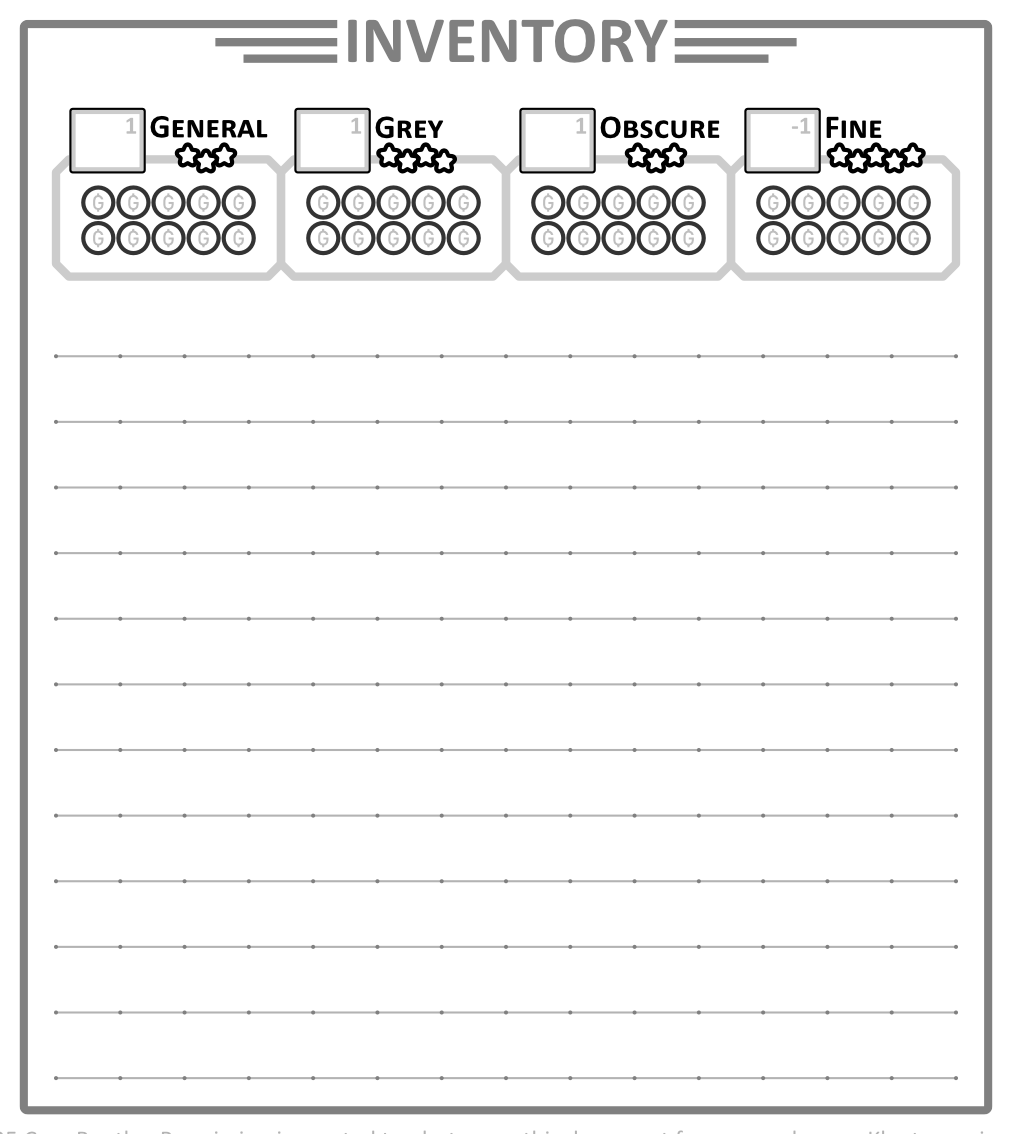
When you gain new Items, add them to your Wealth Box under "Inventory". You may also want to note an Item's effects, number of uses, and Item Grade.
To avoid a tedious game of "loot everything you see", your character also has an abstract system of tracking loot using Wealth Skills and Goods. Both the Wealth Skills and Goods come in four Wealth Categories. Your Wealth Skills and Goods allow you to improvise and actualize items long after you have looted and left a room. Your Wealth Skill and Goods are found at the top of the Wealth Box.
Wealth
There're four Wealth Categories, each representing a different area of the economy. Each Adventurer will have their own balance of these categories that will change what Items they can find in the world and barter for in cities.
General Wealth
- Widely available items.
- Food, first aid, most raw materials, common tools, household objects, standard weapons and armor, etc.
Grey Wealth
- Illicit and specialty goods.
- Tool kits and traps.
- Poisons, lockpicks, climbing gear, forgery kits, ball-bearings, caltrops, bear traps, etc.
Obscure Wealth
- Magical ingredients and gear that are rare and difficult to handle and work with.
- Magic scrolls, mana potions, eyes of newt, phoenix feathers, crystal balls, pendulums, dousing rods, hag stones, etc.
Fine Wealth
- Highly valuable materials and powerful magic items.
- Diamonds, pearls, gold nuggets, enchanted weapons, enchanted clothing, etc.
Wealth Skills
Your four Wealth Skills are Modifiers representing how skilled you are in noticing, appraising, recovering, and trading Items in a given Wealth Category.
All Wealth Skills start as a Modifier of +1 except your Fine Wealth Skill, which starts at -1. You can Improve your Wealth Skills through Archetype Perks, making it easier to get better Items when you Item Search. The GM may also grant you an Improvement to your Fine Wealth Skill if you gain social connections with the right people or reach new milestones of influence in the community.
Over the course of the game, you should give out two Fine Wealth Skill Improvements. You should try to grant these Fine Wealth Skill Improvements as a result of Adventurers gaining new important connections and becoming more influential in the community.
If Adventurers were to ever destroy those connections or tarnish their reputation, it may make sense to remove the Wealth Skill Improvement as a way to reflect that change. That said, Adventurers should be aware of these consequences before they happen and be given a clear choice or chance to prevent it.
Goods
The bubbles below each Wealth Skill tracks your current number of Goods in a given Wealth Category. Goods abstractly represent what you have gathered on your journey.
You will most often gain Goods from engaging with the world, exploring and succeeding in battle. The GM will often reward you with half of a Good at a time, though they may reward you with more if you are clever. (Each bubble for marking Goods has a line dividing it in two for noting half-Goods.)
All Good categories have a max of 6 Goods. Once you have hit the max of 6 Goods in a category, your pack will be unable to carry more. At that point you will want to use your Goods or trade them for a different type of Good.
At Level 1, you start with 2 General, 2 Grey, and 2 Obscure Goods. You can use the Item Trade and Item Search Abilities to gain your starting gear, though your GM may want to be present when you perform the Tests for Item Search.
Using Goods
The most common way you will use your Wealth Skills and Goods is with the Item Search Ability.
To use the Item Search Ability, you will first choose an Item from the Item List (in the Appendix) that you hope to gain explicitly into your inventory. The Item you chose will list a Wealth Category associated with it. You will need to spend 1 Good of that Wealth Category, then roll your Wealth Skill for that same Wealth Category to determine your Item Search Score. The Score you get will determine if you gain the Item as well as what Item Grade it will be.
If ever an Item lists more than one Wealth Category, you can choose which Wealth Category to pull from, but the Wealth Skill that you roll must match the Good spent.
Improvised Items
At times, you will want to search for generic items that are not found in the Item List, like a bar of soap or a candlestick. For these items, the GM will determine how common the item is and what Wealth Category the item may fit into. You will then roll the Item Search Ability as normal using the Wealth Category chosen. If you Fail to get a Score that matches the rarity of the item, you may not get the item or get a flawed version of the item, like a fraying rope or a nearly-spent candle. To help with identifying the Wealth Category and Score needed for improvised items, the Item Search Ability lists some examples for the different Wealth Categories and Score Ranges.
Below is the Item Search Ability as found in the Basic Ability List appendix:
#Alice needs a Spell Scroll in order to cast Feather, which is a Spell that she does not know:
- #Alice looks up the Spell Scroll item in the Item List. She finds that the scroll is an Obscure Item.
- #Alice spends 1 Obscure Good and rolls a
d10, adding her+1Obscure Wealth Skill to find her Score. #Alice gets a Score of9. - With a Mixed Score, #Alice can add a C-Grade Spell Scroll to her inventory. #Alice Notes the Feather Spell Scroll, also choosing two Upgrades for the Spell Ability.
#Bob needs a First Aid Kit to prepare for a battle to come:
- #Bob looks up the First Aid Kit in the Item List. He finds that it is a General Item.
- #Bob spends 1 General Good and rolls a d10, adding to it his
+2General Wealth Skill to find his Score. #Bob gets a Score of10. - #Bob can add an A-Tier First Aid Kit to his inventory.
Bartering
If ever you find your Goods getting out-of-balance with one another, you can always find a marketplace and perform the Item Trade Ability to re-balance your pack or sell old items you don't need anymore:
Item Trade
Items
You can find most of the items you will need to use throughout the game in the following appendices:
- Item List: A list of items that you will use more often. These often help solve problems and survive in encounters. The Item List contains First Aid Kits, Lockpicks, Spell Scrolls, magic items, etc.
- Special Items: A list of unique Items reserved for the GM or certain Abilities. Adventurers cannot gain these through a regular Item Search.
Item Grades
Items in the Item List appendix list a set of Scores that will determine what Item Grade you get from the Item Search Ability. The Item Grade represents the quality and condition of the item.
Score Ranges and their Item Grades:
- [..6] (F)lawed Items
- [7..9] (C)ommon Items
- [10..] (A)wesome Items
- [10!] (S)uperior Items
As you occasionally give out items, be sure to include Items of a lower Score. Flawed Grade Items, like the lowest tier of the Wand of Teleportation can add a lot of flavor and to the story and force Adventurers to think more before using their Items.
The Special Items are also divided into two levels:
- SS - Super Special Items
- SSS - Singularly Super Special Items
The Special Item List is reserved as rewards that can only usually be gained from you, the GM. Below is an example schedule for when to hand out these special rewards to each Adventurer:
- By Level 5: Grant 1 SS Item.
- By Level 7: Grant 1 SS Item with the 'Consumed' Item Tag.
- By Level 10: Grant 1 SS Item.
- By Level 12: Grant 1 SSS Item with the 'Consumed' Item Tag.
- By Level 15: Grant 1 SSS Item.
Try to give Adventurers Items that complement their character, accentuating their character design and goals. These Items should also be hinted at or teased ahead of time, getting Adventurers excited for their arrival.
Selling Items
An Item's Grade also comes into play when trying to sell an item using the Item Sell Ability:
Item Sell
Item Example
Below is an example of an Item Block and the details you can expect to find in the Item List:
The first lines within the item block is a summary containing the item's Wealth Category, Item Tags, and a summary effect.
After the summary is a visual description of the item. This flavor text is a suggestion that helps add consistent, descriptive flair to your game.
After the visual description is the item's mechanical description. Here you will find a full description of how the item works. This description is often accompanied by an Ability that you can perform with that item.
Item Tags
Items will often list Item Tags at the top of their item block. Item Tags help identify common rules that that item must abide by. Below are some of the most common Item Tags to be aware of:
- Jealous. The item can become "jealous" of other items that have this same Item Tag. (More on this below. See Item Jealousy below.)
- Consumed. The item can only be used once. These items usually have stronger effects. Don't be afraid to use these items, as the 'Multipack' Bonus on the Item Search Ability can give you Advantage when trying to find Consumed items again if you have used them once before.
- Wield. Items with this Item Tag can be used to empower your Abilities. If you are ever Disarmed, you will drop that Wielded Item as a result.
Item Jealousy
Some items don't work well together. In the case of magical Items, they often grow attached to their user and can become "Jealous" if you use other Items instead of them.
To represent this relationship, you will start with a number of Friendship Points equal to your Fine Wealth Skill. Whenever you improve your Fine Wealth Skill, you will gain another Friendship Point to use.
Whenever you use an item with the Jealous Tag, you will have to make any Ability Tests with 2 Disadvantages. If you get a Passing Score on any Test with a Jealous Item, you then must place one of your Friendship Points onto that item, unless the item already has 2 Friendship Points. For each Friendship Point on an Item, you can ignore one of the Disadvantages for that Item. As you foster your bond with your items, you will ensure that future Tests with those Items are more likely to succeed. Be careful when using multiple Jealous Items, though. If you have no free Friendship Points, a Passing Score will force you to take a point from one of your other Jealous Items.
Previous Owners
If a Jealous Item had a previous owner, it may come with Friendship Points from that owner. When using such an item, you will have the usual 2 Disadvantages, but getting a Passing Score will instead remove one of the previous owner's Friendship Points instead of assigning one of yours. It won't be until you clear all of the previous owner's Friendship Points that you will be required to assign one of your own Friendship Points.
Next Up: 3.6. Status Box