1.7. Damage
Damage Types
All Damage comes with a Damage Type. Each Damage Type has a Major and a Minor component.
The Major Damage Types are: Solid, Fluid, Ethereal, and True Damage.
The Minor Damage Types are: Blunt, Sharp, Shock, Fire, Ice, Caustic and Planar.
Each weapon, and Ability that deals damage will list its Major Damage Type and Minor Damage Type unless it deals True Damage.
Below is a chart that provides basic examples each major/minor combination.
| Solid | Fluid | Ethereal | |
|---|---|---|---|
| Blunt | Blunt weapons, blunt projectiles | Shockwaves, Crushing Gravity | Psychic slams, Charms, Silvered blunt weapons vs ghosts |
| Sharp | Sharp weapons, sharp projectiles | Sandstorms, Bees | Psychic stabs, Insults, Silvered sharp weapons vs ghosts |
| Shock | Lightning Strikes | Psychic shocks, Paralyzing traumas | |
| Fire | Meteors | Flames | Radiance |
| Ice | Solid chunks of ice | Ice beams, cold auras | Void Influences, Fears, Dementias |
| Caustic | Acids | Poisons | Necrotics |
| Planar | Planar instabilities | Temporal or Spacial inconsistencies | Fey influences, Manias |
| Your GM may choose create a new Minor Damage Type or use combinations beyond those above. Generally speaking, you can think of the Major Damage Types as: |
- Solid Damage - Armor or other physical defenses slow it before it can hit you.
- Fluid Damage - Can seep through cracks or permeate through cloth, armor, or leather.
- Ethereal Damage - Bypasses physical protections altogether using the ether.
- True Damage - A special and rare Major Damage Type that comes with no Minor Damage Type. This Damage is unavoidable. Creatures cannot block or reduced in any way. True Damage always skips past Defenses and your Shield, getting applied directly to your Health or Vitality.
Falling
If ever you fall more than a Spearing Distance(2u), you may be in danger! Lets take a look at the handy chart included on Page 1 of the #cheat_sheet:
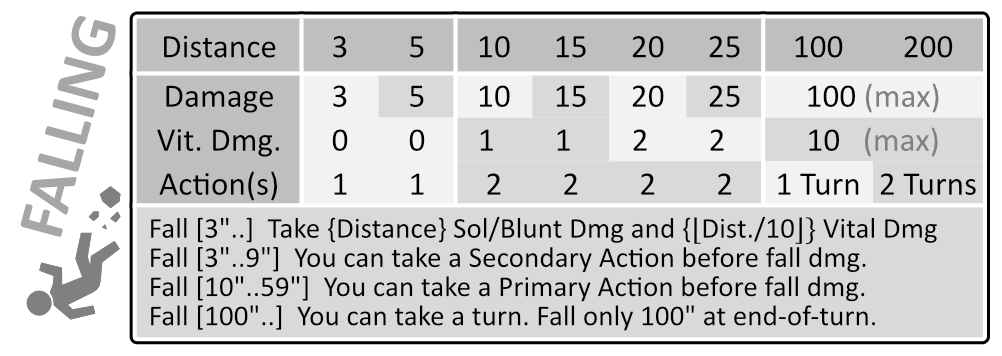
At the top of this chart is the distance to the ground in units. Below that you will find the number of Beats you can take on your next Turn before you fall and take Damage and the amount of Damage that you will take upon hitting the ground.
The distance that you fall correlates directly with the amount of Damage that you will take when you hit the ground. If you fall 8 units, you will suffer 8 Solid/Blunt Damage. If you fall 79 units, you will suffer 79 Solid/Blunt Damage. Like with all Damage, one tenth of the Damage you take, rounded down, you will need to subtract from your Vitality. Fall Damage has a cap of 100 Solid/Blunt Damage (terminal velocity.) You will also not take any Damage for falling a Spearing Distance(2u) or less.
You will have a chance to act before you hit the ground. Regardless of when your fall begins, you will wait to resolve the motion of your fall until your next Turn. When you end your next Turn, you will fall a Sniping Distance(100u). If you hit the ground during that motion, you take the resulting Damage (as described above.) You can, optionally, choose to fall any of the Sniping Distance(100u) before or between any other Abilities on your Turn, allowing you to time your actions with your fall. If you hit the ground while falling early, you will take the resulting Damage immediately (as described above.)
Since you will resolve your fall on your Turn, there is a chance others can save you by acting before your Turn starts. If you want to break the fall of another character, you will need to take half of their total fall Damage, rounded down.
The Feather Spell, Tumble Ability, Cat Fall Ability, and some items like a net can help you avoid Damage from falling or catch someone else that is falling. Don't be afraid to improvise solutions to the problem of falling.
Traps
You will often encounter Traps as you explore dungeons infiltrate the camps of others. Some Traps, like the Bear Trap, will trigger instantly, but larger Traps work in much the same way that Falling does.
When you trigger a Trap, the GM, or Adventurer that laid the Trap will describe the first moments of the Trap as it's triggered. The GM or Adventurer will give you clues to what is about to happen. You will then have a small window of opportunity to act.
If you trigger a Trap during the Freeplay phase of the game, all your allies will need to perform the Trap's Save. Allies that Pass the Save will have a chance to act before the trap closes on you. If an ally is able to help you in a meaningful way, the GM will allow you to escape or grant you an Advantage on the final Save of the Trap. Your allies do not have to help you, if they do not want to or cannot help you in a meaningful way.
If you trigger a Trap during an Encounter, allies don't need to make a Save. Instead, the Trap will take effect at the start of your next Turn. If you are not out of the way of the Trap when your next Turn starts, you will need to perform any Saves for the test and suffer the Trap's effects.
There're simple ways that an ally can help. An ally could try to push you out of the way of the Trap. To push someone, you can use the Grapple Ability. If the target is willing, the Grapple Ability can be an automatic Mixed Score. Attempting to save someone could put you in the way of the Trap, if you roll a Low Score or Mixed Score. In those cases, you will need to perform the final Save against the Trap and you may experience the effects of the Trap.
Next Up: 1.8. Zones